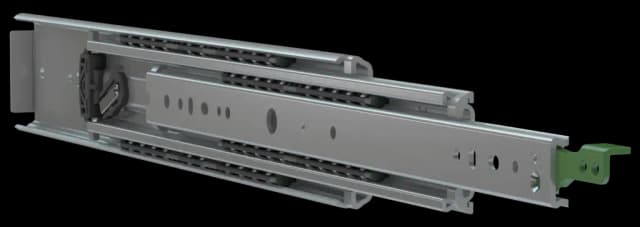
Drawer runners, also called drawer slides or telescopic slides, are pairs of steel or aluminium rails that let a drawer, tray or equipment shelf roll out on ball bearings. One member fixes to the cabinet and one to the drawer, and in most designs an intermediate member sits between them so the drawer can travel further than a single rail would allow.
1. Start with the load
Add up the weight of the drawer itself and everything that will ever go into it. Then compare that figure with the slide’s load rating at the extension you need. Check whether the datasheet quotes the rating per slide or per pair, and whether it assumes a particular slide length.
- Light duty runners suit cabinet drawers, keyboard trays and enclosures carrying a few tens of kilograms.
- Medium duty runners suit tool storage, equipment trays and workshop cabinets.
- Heavy duty runners carry battery banks, generators, vehicle storage modules and machinery. The heaviest ranges are rated above 1,000 kg.
Allow a margin for shock and vibration. A drawer in a moving service vehicle or on a mine site sees far higher peak loads than one in an office, and the runner must survive the bumps as well as the static weight.
2. Check the mounting orientation
Most load ratings assume the slide is mounted on its side, with the ball tracks vertical. Mounting a slide flat under a shelf usually reduces its capacity considerably. If your design needs flat mounting, choose a slide rated for it and check the datasheet figure for that orientation.
3. Choose the extension
- Partial extension (roughly three-quarters of the slide length) is compact and economical where you don’t need to reach the back of the drawer.
- Full extension brings the whole drawer out of the cabinet, so the back of the drawer is accessible.
- Over-extension travels further than the slide length, so the drawer clears the front frame or a worktop. It is useful for top-loading equipment.
- Two-way extension lets the drawer pull out to either side of the cabinet, for example in vehicles or between workstations.
4. Get the length and side clearance right
The closed length of the slide should match the depth inside the cabinet. Runners come in standard length steps, so pick the longest standard length that fits. The travel (stroke) then follows from the slide type.
Each runner also needs space beside the drawer. The cabinet opening must equal the drawer width plus the thickness of two runners, plus a small installation tolerance. Getting this gap wrong is the most common reason a drawer binds or sags.
5. Add the features you need
- Lock-in keeps the drawer shut during transport, which is essential in vehicles.
- Lock-out holds the drawer open so it can’t roll back while someone works.
- Disconnect lets you lift the drawer out completely for servicing.
- Soft-close or self-close pulls the drawer shut gently over the last few centimetres.
6. Match the material to the environment
Zinc-plated steel suits most indoor and vehicle applications. Stainless steel slides suit food processing, marine and outdoor installations where corrosion would seize a standard runner. Aluminium slides save weight where every kilogram matters, such as on mobile equipment.
What to send us for a quote
Tell us the total load, the cabinet depth, the extension you need, how the slide will be mounted, the quantity and the environment. With those six facts our team can recommend a slide and confirm stock and lead time.
Frequently asked questions
Is a drawer runner the same as a drawer slide?
Yes. "Drawer runner" is the common South African and British term, while "drawer slide" and "telescopic slide" are used more in technical datasheets. They describe the same ball-bearing component.
What does full extension mean?
A full-extension runner lets the drawer travel out by the full length of the slide, so the back of the drawer clears the cabinet front and everything inside is reachable.
Can heavy-duty drawer runners be mounted flat?
Some can, but most load ratings assume side mounting. Mounting a runner flat usually lowers its capacity, so check the rating for flat mounting on the datasheet or ask us to confirm.