Both are blind fasteners: they are installed from one side of the work piece, and a tool pulls part of the fastener back so it collapses or flares behind the panel. A blind rivet makes a permanent joint. A rivet nut leaves a threaded hole, so you can bolt something on, and take it off again, later.
Rivet nuts (blind threaded inserts)
Rivet nuts are also called blind threaded inserts, rivnuts or nutserts. Use them where the material is too thin to tap, where a weld nut would distort the panel, or where you can’t get behind the panel to hold a nut.
Body style
- Round, smooth body: the simplest and cheapest type, for light-duty threads.
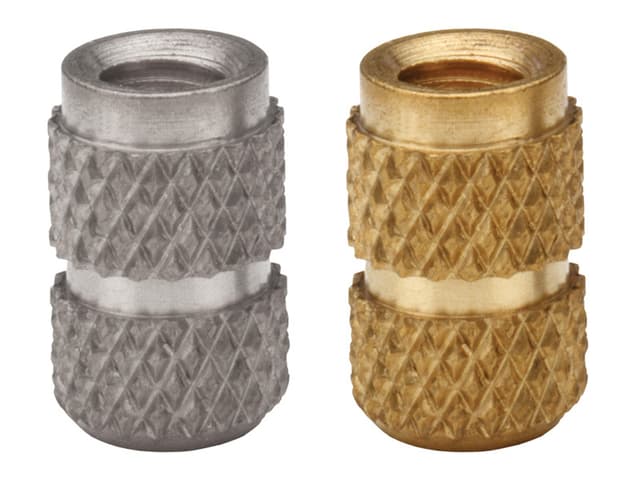
- Round, knurled or splined body: the knurls bite into the hole wall and resist spin-out when the bolt is tightened.
- Hexagonal or half-hex body: the best resistance to spinning, installed in a matching hex hole.
Head style
- Flat or large flange: spreads the load, which suits soft or thin materials.
- Countersunk or thin head: sits flush or nearly flush, so the mating part lies flat.
Open or closed end
Open-end rivet nuts are the general-purpose choice. Closed-end types seal the hole against water, dust and fumes, which matters on vehicle bodies and enclosures.
Grip range and hole size
Every rivet nut is designed for a range of material thicknesses, its grip range, and a specific hole diameter. Outside that range the nut won’t clamp properly and may spin. Always drill to the size on the datasheet.
Blind rivets
A blind rivet (often called a pop rivet) has a hollow body and a mandrel. Pulling the mandrel expands the body behind the panel, then the mandrel snaps off.
- Dome head is the standard choice. Countersunk heads sit flush. Large flange heads spread the load on soft materials.
- Open-end rivets are general purpose. Closed-end (sealed) rivets keep out water and gas.
- Multi-grip rivets cover a wider range of material thicknesses with one size.
- Structural rivets lock the mandrel inside the body for higher shear strength and vibration resistance, for trailers, truck bodies and frames.
Choose the material to avoid corrosion
Match the fastener to the parts it joins. Aluminium rivets suit aluminium sheet, and stainless steel rivets suit stainless steel. Mixing metals in a wet environment causes galvanic corrosion, which can loosen or destroy the joint.
Installation tools
Hand tools are fine for repairs and small batches. For production work a pneumatic-hydraulic tool sets fasteners quickly and consistently. Make sure the tool’s nose piece or mandrel matches the fastener size.
Rivet nut or self-clinching nut?
If you can reach both sides of the panel and press the part in during fabrication, a self-clinching nut gives a neater, stronger permanent thread in sheet metal. If you can only reach one side, or the part is already assembled, use a rivet nut.
What to send us for a quote
Send the thread size (or rivet diameter), the material thickness, the base material, the head style and the quantity. If you are matching an existing part, a photo and measurements are enough for us to identify it.
Frequently asked questions
What is the difference between a rivet nut and a blind rivet?
A blind rivet makes a permanent, unthreaded joint. A rivet nut is installed the same way but leaves an internal thread, so parts can be bolted on and removed later.
What size hole do I need for a rivet nut?
Each rivet nut has a specified hole diameter, usually a little larger than the body. Drilling to that exact size is essential, because an oversize hole lets the nut spin and an undersize hole stops it seating.
Can rivet nuts be used in thin sheet metal?
Yes, that is their main purpose. Choose a type whose grip range covers your sheet thickness, and consider a large-flange or knurled body for thin or soft material.